Flood-GAN
A physics-aware conditional GAN that turns all-weather Sentinel-1 radar into optical-style imagery and a water mask, so floods can be mapped through cloud.
Overview
Floods come with clouds, and clouds blind optical satellites exactly when maps are needed most. Radar sees through them but is hard to read.
Flood-GAN translates Sentinel-1 radar into Sentinel-2-style optical images and predicts where the water is, with losses that encode how radar and water actually behave.
The problem in one picture
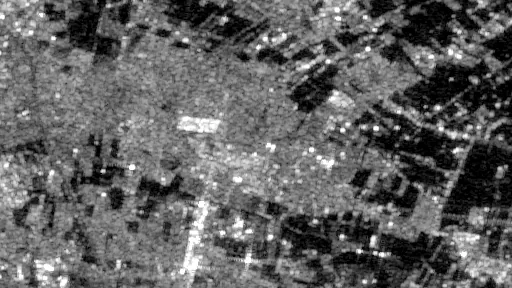 Sentinel-1 radar
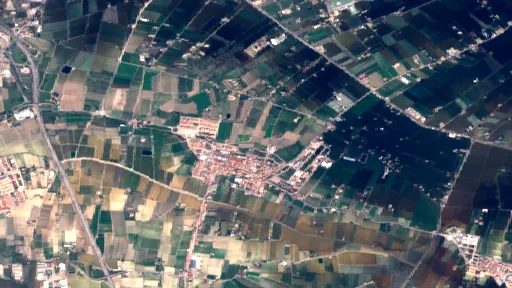 Sentinel-2 optical
Model
Radar input is two polarizations, VV and VH, each cleaned with a 5×5 Lee speckle filter. The generator is a U-Net, an encoder-decoder with skip connections and a self-attention block at the bottleneck, and it outputs four channels: three for the optical image and one for the water mask.
A PatchGAN discriminator judges realism patch by patch, trained with a least-squares GAN loss and label smoothing for steadier gradients.
Physics-aware losses
The generator is trained on a weighted sum of five terms:
| Loss | What it enforces | Weight |
|---|---|---|
| Adversarial (LSGAN) | Outputs that look real to the discriminator | 1 |
| Masked L1 | Pixel accuracy, but only on cloud-free pixels, so partly cloudy scenes still teach | 100 |
| Masked perceptual (VGG) | Natural texture and structure on clear regions | 10 |
| Speckle preservation | No invented texture where the radar is smooth, such as calm water (Sobel gradients) | 1 |
| Water consistency | The water mask matches the labels, and the image’s water index agrees with it | 5 |
Weights from the training config in the repository.
Training
Trained with PyTorch Lightning on 512×512 chips in 16-bit mixed precision, using Adam at a 2e-4 learning rate (β1 = 0.5) and batch size 8 for up to 200 epochs, with a Prometheus and Grafana stack for monitoring.